E8 Markets FTMO Head to head · 33 criteria compared

E8 Markets vs FTMO: which prop firm is better in 2026?

Across pricing, rules and payout terms, FTMO takes the lead (8 against 4). and it pays out a larger share of profits, so the choice is not automatic.

Verified on
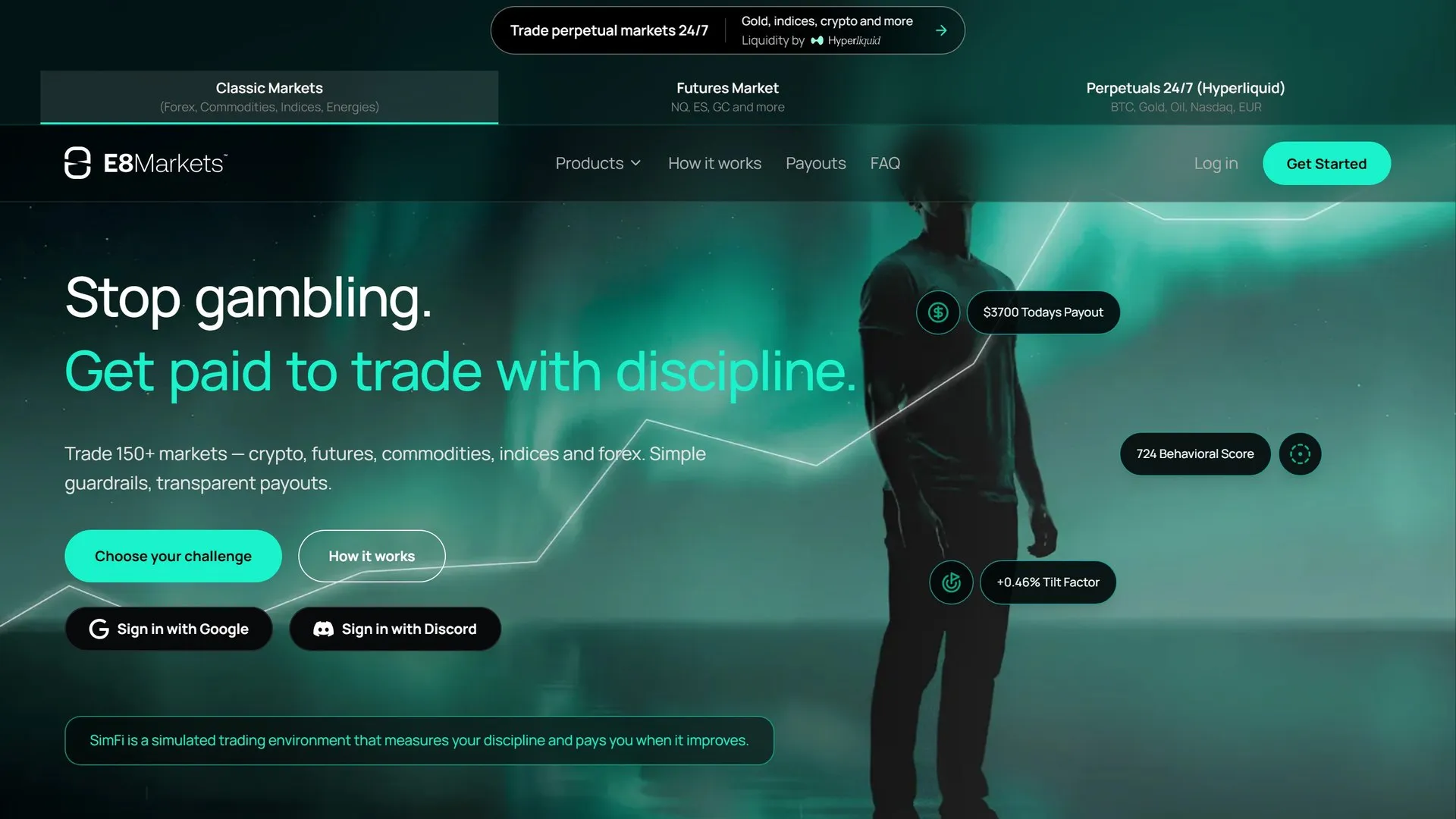
E8 Markets homepage: headline "Stop gambling. Get paid to trade with discipline." over a backlit silhouette, 150+ markets and Google or Discord sign-in
E8 Markets

E8 Markets

Forex / CFD · Crypto · Futures

Every E8 Markets product is now single-phase: a 6% target, withdrawals available from day three, and a split running from 80% to 100%. The trade-offs are a 35-40% consistency rule, no scaling plan, and a Trustpilot rating suspended in August 2026 for a breach of the platform's guidelines.

Criteria won: 4 / 33

FTMO homepage: 1-step challenge offer on a $100,000 account and Trustpilot rating
FTMO

FTMO

Forex / CFD · Crypto · Stocks Trustpilot 4.8 / 5 (50,580 reviews)

Founded in Prague in 2015, FTMO reports more than $450 million paid to traders and closed its acquisition of broker OANDA in December 2025. The 2-Step challenge, static drawdown and no deadline, remains its core product, with fees fully refunded on the first payout. Price is the weak spot, and it rose again in 2026.

Criteria won: 8 / 33

Pricing at equal account size

Cheapest evaluation for a 100 K account.

E8 Markets E8 Markets

$260

FTMO FTMO

€499

E8 Markets vs FTMO (2026) — Full Comparison
Full comparison E8 Markets E8 Markets FTMO FTMO
Trust
Score 76/100 88/100 ✓
Trustpilot — 4.8/5
Founded 2021 2015 ✓
Headquarters US CZ
Pricing
Entry price $110 €79 ✓
Price for a 100 K account $260 ✓ €499
Refundable fee No Yes ✓
Reset price — —
Account sizes 500 K ✓ 200 K
Rules
Steps 1 1
Profit target 6 % ✓ 10 %
Max daily loss — 3 %
Max total drawdown — 10 %
Drawdown type — Static
Time limit Unlimited Unlimited
Consistency rule 35 50 ✓
Min trading days — —
Payouts
Profit split 80 % 80 %
Max profit split 100 % ✓ 90 %
First payout — 14 days
Payout frequency On demand (daily on E8 Pro; minimum $100) On demand from the 14th day after the first trade, then every 14 days
Payout methods rise —
Scaling plan No Yes ✓
Max allocation 500 K 2 M ✓
Trading
Platforms and instruments mt5, ctrader, tradelocker, match-trader mt4, mt5, ctrader, dxtrade, tradingview ✓
Instruments fx, indices, metals, energy, crypto, futures fx, indices, metals, energy, crypto, stocks
Leverage Forex 1:30, indices 1:15, metals 1:15, crypto 1:1 1:100 (forex)
News trading Yes Yes
Weekend holding Yes Yes
Expert Advisors — Yes
Copy trading Restricted Restricted
Scalping — Yes
Hedging — Yes

E8 Markets Choose E8 Markets if…

  • You need a platform FTMO does not offer: tradelocker, match-trader.
  • You expect to stay funded long enough for the split to matter: 100 % against 90 % at FTMO.

FTMO Choose FTMO if…

  • Your budget is the binding constraint: the entry ticket starts at €79, below E8 Markets.
  • You need a platform E8 Markets does not offer: mt4, dxtrade, tradingview.
  • You are aiming for size: allocation scales up to 2 M.

Our analysis

Track record

FTMO has been running since 2015, 6 years longer than E8 Markets. Our trust pillar scores them 74/100 and 97/100, which weighs age, corporate transparency and public payout evidence. In an industry with no financial regulator overseeing these evaluations, longevity and a verifiable payout history are the closest thing to a guarantee.

What you pay to start

FTMO opens at €79 against $110 for E8 Markets, a moderate gap on the smallest account. At the reference size of 100 K the comparison is $260 for E8 Markets against €499 for FTMO. The headline fee is rarely the real cost, though: what matters is the price of a reset after a failed attempt, whether the fee comes back on the first payout, and whether an activation fee appears when you move to a funded account. Compare those three lines in the table above before deciding on price alone.

Drawdown: the rule that decides

E8 Markets does not publish a clear drawdown model. FTMO applies a static drawdown capped at 10 %, with a 3 % daily limit. This is the single most consequential difference between the two. A static drawdown is measured once, from the starting balance, and never moves; a trailing drawdown follows your equity upward, so a winning streak raises the floor you can no longer fall below. Intraday trailing is stricter still, because it tracks unrealised peaks reached inside the session — profit you never actually banked can permanently raise your loss threshold.

What reaches your account

E8 Markets keeps 100 % of profits, then pays On demand (daily on E8 Pro; minimum $100). FTMO keeps 90 % of profits, allows a first withdrawal after 14 days, then pays On demand from the 14th day after the first trade, then every 14 days. Payout frequency deserves as much attention as the split itself: a slightly lower share paid every two weeks compounds faster than a headline percentage locked behind a monthly cycle and a long first-withdrawal delay.

Where you actually trade

E8 Markets is the only one of the two to offer tradelocker, match-trader. FTMO covers mt4, dxtrade, tradingview, which its rival does not. Platform choice is not cosmetic: order execution, available order types and the reliability of your automation all depend on it, and switching mid-evaluation is rarely possible.


Other comparisons

Frequently asked questions

Which is better between E8 Markets and FTMO?
FTMO wins 8 of the 33 criteria we compare, against 4 for E8 Markets. That said, the ranking depends on what you weight: entry cost, drawdown model and payout speed do not point in the same direction for every trader.
Which of the two is cheaper?
FTMO, with an entry price of €79 against $110. Check the reset price and whether the fee is refunded on the first payout before concluding — those two lines often reverse the ranking.
Which one offers the larger accounts?
E8 Markets, up to 500 K against 200 K. Remember that a bigger account also means a bigger absolute drawdown to respect.
Can I run both at the same time?
Nothing prevents you from holding accounts at two different firms — many funded traders do, to spread the risk of a single firm changing its rules or delaying a payout. What is usually forbidden is mirroring the same trades across accounts, which most firms treat as copy trading and can void a payout. Check each firm's terms on that specific point.

Discounts that are actually verified

No discount code is published without being checked on the firm’s own website. An unverified deal does not appear here.

See the discounts